← Selected work

Independent system / 04 / Expert-led automation

FlowPilot

An AI workflow automation application for launching, tracking, and reviewing bounded workflows. The repository includes a durable PostgreSQL + Redis/RQ worker topology; the currently hosted portfolio demo uses a lighter inline-background execution mode with ephemeral run state. Both modes keep workflow orchestration, approval boundaries, and operational visibility explicit rather than hiding everything inside a synchronous prompt.

Independent engineering build · Not a client case study
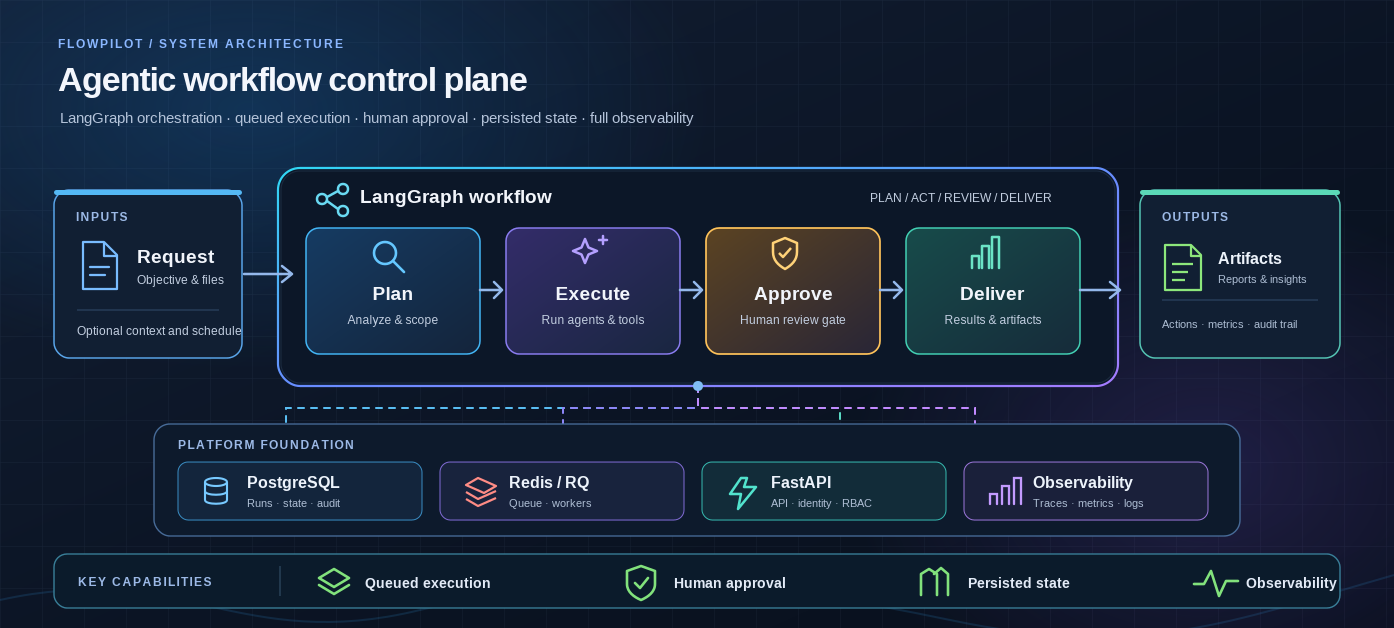
Illustrative FlowPilot architecture infographic showing request inputs, a LangGraph multi-expert workflow with plan, execute, approve and deliver stages, output artifacts, and its PostgreSQL, Redis/RQ, FastAPI and observability foundation. Not a captured application screen.
Illustrative architecture visual — not a captured application screen or customer deployment.

The problem

What the system addresses

LLM automation becomes difficult to operate when long-running work, retries, approvals, and state are hidden inside a request-response cycle.

The implementation

How it is approached

Separate orchestration from execution, provide a durable stateful worker deployment option, and expose progress and approval boundaries explicitly. Disclose the hosted demo’s lighter ephemeral execution mode separately.

Who it is for

Operations and product teams coordinating multi-step work across people, approvals and connected tools.

Coordinate asynchronous AI workflows with queued execution, human approval, persisted state and observable outcomes.

Independent engineering build. This reference is not a client case study; no customer deployment, testimonial or business-outcome metric is claimed.

Inspectable implementation evidence

What can be verified in the build.

  • LangGraph workflows are separated from FastAPI request handling and execution.
  • The repository contains a durable PostgreSQL + Redis/RQ worker topology; the hosted portfolio demo currently uses inline background execution and ephemeral state.
  • Role-scoped access, approval boundaries, and optional observability integrations are part of the implementation.

Local validation snapshot · 16 November 2026 · Docker Compose

  • 94 automated tests passed.
  • 4 of 4 evaluation cases passed.
  • 4 of 4 named workflow smoke checks completed after services became ready: content, competitor, outreach and KPI.
  • Human approval endpoint returned a successful response in the smoke run.

A first competitor run was submitted while LiteLLM was still becoming reachable and failed with a connection error. After the services were ready, the competitor workflow was replayed successfully and all four named smoke checks completed. This is a dated local validation snapshot, not a production-availability or customer-outcome claim. The currently hosted Render demo separately reports inline-background execution with ephemeral-memory state; durable PostgreSQL/Redis worker execution requires the distinct production Blueprint.

System map

Architecture and workflow

  1. 01API command center
  2. 02Workflow definition
  3. 03Queue + worker execution
  4. 04Persistence + state transitions
  5. 05Approval / validation
  6. 06Result + observability

Implementation detail

Engineering decisions and reliability

LangGraphFastAPIRedis/RQPostgreSQLObservability

Design decisions

  • Use async jobs for long-running AI work
  • Provide a durable state mode outside process memory while documenting ephemeral state in the lightweight demo
  • Keep human approval explicit
  • Treat provider failures as recoverable states

Reliability considerations

  • Retryable workers
  • Persisted state
  • Approval gates
  • Request correlation
  • Health/readiness checks

Build notes

From problem to implementation

01 / Situation

AI automation becomes difficult to operate when long-running work, retries, approvals, and state live inside fragile synchronous requests.

02 / Task

Build a production-minded AI automation control plane that treats experts as durable workflows instead of isolated prompts.

03 / Action
  • Separated API orchestration from execution with FastAPI, Redis/RQ workers, PostgreSQL persistence, and LangGraph workflows.
  • Added human approval boundaries, evidence and validation for external-impact workflows, plus scheduled automation.
  • Instrumented the system with Prometheus/Grafana metrics and OpenTelemetry/Jaeger traces and added CI evaluation coverage.
04 / Result
  • Created an operations-oriented architecture for content, competitor, outreach, and KPI automation patterns.
  • Made workflow progress, audit state, approvals, retries, and observability first-class rather than hidden behind the LLM call.