← Selected work

Independent system / 02 / Verified RAG & research

EvidenceFlow

A LangGraph-based RAG system designed around evidence rather than raw model confidence. It routes between knowledge-base retrieval and web research, uses hybrid retrieval with reciprocal-rank fusion and reranking, and verifies answer claims against collected evidence.

Independent engineering build · Not a client case study
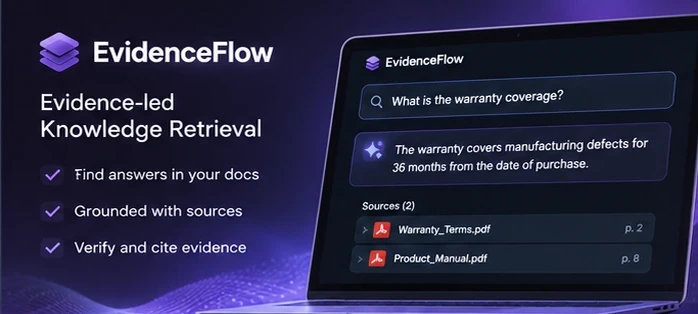
Illustrative engineering workbench visual. Open the project overview for details of the actual workflow and architecture.
Illustrative product visual using synthetic data — not a captured customer deployment or live application screenshot.

The problem

What the system addresses

RAG systems can retrieve plausible text while still producing unsupported claims or overconfident answers.

The implementation

How it is approached

The pipeline separates retrieval, evidence synthesis, citation verification, and answer policy so unsupported responses can fail closed instead of being presented as fact.

Who it is for

Knowledge, compliance, operations and support teams that need answers tied to inspectable source material.

Hybrid retrieval, reranking, web research, evidence verification, and fail-closed answer generation.

Independent engineering build. This reference is not a client case study; no customer deployment, testimonial or business-outcome metric is claimed.

Inspectable implementation evidence

What can be verified in the build.

  • OpenSearch inverted-index retrieval with BM25, exact, phrase, fuzzy and metadata-aware matching.
  • Optional neural-sparse retrieval, reciprocal-rank fusion and cross-encoder reranking.
  • Citation verification, evidence-conflict checks and an explicit insufficient-evidence outcome.

System map

Architecture and workflow

  1. 01Query understanding + routing
  2. 02Dense + lexical retrieval
  3. 03RRF fusion + cross-encoder reranking
  4. 04Evidence synthesis
  5. 05Citation / claim verification
  6. 06Final guarded response

Implementation detail

Engineering decisions and reliability

LangGraphQdrantBM25RRFTavily

Design decisions

  • Preserve evidence IDs through the graph
  • Keep tool execution provider-agnostic
  • Use deterministic citation checks
  • Separate document summaries from chunk analysis

Reliability considerations

  • Evidence-grounded synthesis
  • Citation verification
  • Fail-closed behavior
  • Hybrid retrieval
  • Regression diagnostics

Build notes

From problem to implementation

01 / Situation

RAG systems can retrieve plausible text and still produce answers that are unsupported, overconfident, or weakly cited.

02 / Task

Build a research assistant where retrieval, evidence collection, citation verification, and answer policy are explicit parts of the system.

03 / Action
  • Built the retrieval foundation around OpenSearch's inverted index and BM25, supporting exact, phrase, fuzzy, and metadata-aware lexical retrieval without requiring dense-vector k-NN.
  • Added optional neural-sparse retrieval as an additional semantic signal while keeping the core retrieval path vectorless.
  • Combined independently ranked retrieval candidates with reciprocal-rank fusion and Jina cross-encoder reranking.
  • Added adaptive query recovery for weak first-pass retrieval and maintained a turn-scoped evidence registry through the LangGraph workflow.
  • Verified citations and claim support against the actual evidence set and fail closed when sufficient support cannot be established.
04 / Result
  • Created a RAG architecture that remains useful without a dense-vector database while still supporting an additional neural-sparse semantic retrieval signal.
  • Made retrieval strategy, evidence provenance, citations, conflicts, and failure states inspectable rather than relying on model confidence.